

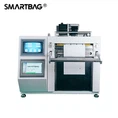
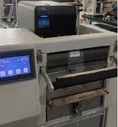

The working principle of the printing system mainly involves the following key steps:
1. Data transmission
When the user issues a print command on the computer, the computer will convert the document or image data to be printed into a specific print language format, such as PostScript, PCL (Printer Control Language), etc. Then, the data is transmitted to the printer through a data cable (such as USB cable, network cable, etc.) or a wireless connection (such as Wi-Fi, Bluetooth, etc.) connecting the computer and the printer.
2. Data processing
After the Thermal transfer overprinting systems receives the data, the data is first processed by the printer's controller. The controller will parse the print language and convert it into an instruction set that the printer can understand, including information such as the position, size, and color of text, graphics, and images.
For some high-end Thermal Transfer Coding Printers, image enhancement and color management are also performed. For example, adjust the contrast, brightness, color saturation, etc. of the image to obtain better printing results.
3. Printing process
How inkjet printers work:
Inkjet printers spray ink onto paper through a series of tiny nozzles. When the controller issues a print command, the ink in the ink cartridge is ejected through the nozzle under pressure.
The printer determines the ejection time and position of each nozzle according to the data to accurately form text and images on the paper. Different colors of ink are mixed together to produce rich color effects.
In order to ensure the quality of printing, inkjet printers may perform multiple ejections to increase the coverage of ink and the vividness of colors.
Working principle of laser printer:
Laser printers mainly use laser beams and photosensitive drums to achieve printing. First, the laser beam scans on the photosensitive drum according to the printing data, so that the surface of the photosensitive drum is charged with electrostatic latent images.
Then, the photosensitive drum with static electricity attracts toner, and the toner forms a toner image corresponding to the printed content on the photosensitive drum.
When the paper passes through the photosensitive drum, the toner is transferred to the paper. Then, the paper passes through the heating component, and the toner melts at high temperature and fixes on the paper to complete the printing process.
Working principle of dot matrix printer:
The dot matrix printer uses the printing needle to hit the ribbon and leave an imprint on the paper. The printing needle is installed on the print head. When the print head moves on the paper, the printing needle hits the ribbon at a specific position according to the instructions of the printing data.
The ink in the ribbon will be printed on the paper through the impact of the printing pin, forming text and graphics. Dot matrix printers can usually print multiple layers of paper, which is suitable for some occasions that require carbon copying, such as invoices, receipts, etc.
In short, the Thermal transfer overprinting systems, with its exquisite working principle, plays an indispensable and important role in various fields of modern society. From office document printing to label production in the commercial field, from high-precision output of artistic creation to photo souvenirs in family life, the printing system meets people's diverse needs with its precise color presentation, clear text portrayal and efficient workflow. With the continuous advancement of technology, we have reason to believe that the printing system will continue to innovate and develop, bring us a more excellent printing experience, and become an important bridge connecting the digital world and the real world. Let us look forward to the printing system creating more excitement and possibilities in the future. If you want to understand the working principle of the printing system, you can consult our professional technicians, and we will serve you wholeheartedly 24 hours a day!